

Trying for a Baby and Everyone Has Advice?

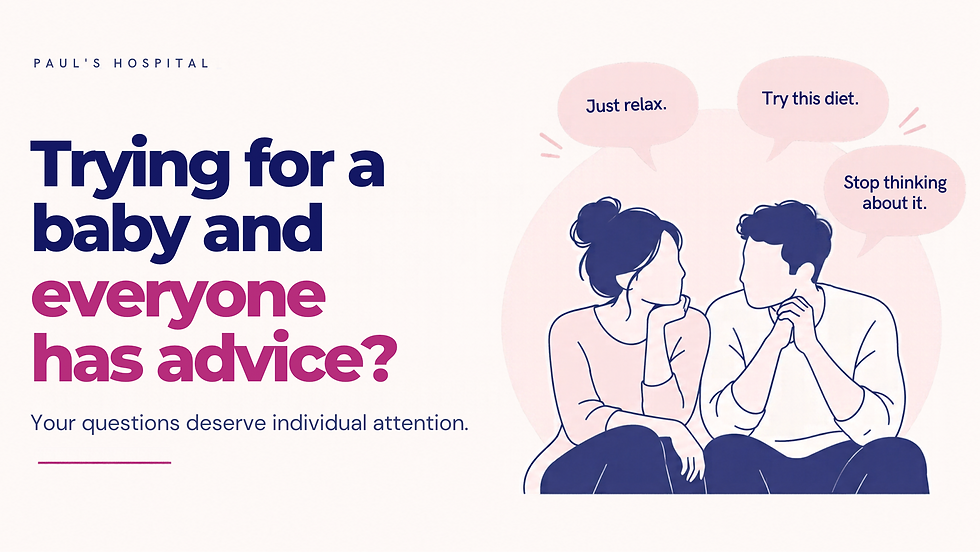
“Just relax.”
“Try this diet.”
“My cousin went through the same thing. Here’s what worked for her.”
When you are trying for a baby, advice can arrive before you have even asked a question. A family gathering becomes a conversation about pregnancy. A message from a friend comes with another supplement suggestion. Someone wants an update you are not ready to give.
People may mean well. It can still feel overwhelming.
Whether you are just starting to plan a pregnancy or exploring infertility treatment in Kochi, you deserve space to make informed decisions and support that respects your privacy.
Why “just relax” can be difficult to hear
Being told to relax can make you feel responsible for something you cannot simply control. It may sound as though pregnancy would happen if you could only worry less.
The relationship between stress and fertility is complex. It is not clear how stress affects the chance of conceiving, and reducing stress alone does not guarantee pregnancy. Support for stress is valuable because your wellbeing matters throughout the process. [1]
You do not need to feel positive all the time. You can be hopeful one day and frustrated the next.
A useful response to unwanted reassurance might be: “I know you want to help. Right now, listening would mean more to me than another suggestion.”
Someone else’s experience is not your treatment plan
Personal stories can offer comfort. They can also create pressure to repeat another person’s decisions.
Before acting on a recommendation, turn it into a question for your clinician: “Would this be relevant to us? What is the evidence, and what are the possible downsides?”
The same approach works for social media. Save questions you want answered instead of building a checklist of everything someone says you should try. You are allowed to stop reading when the information becomes more exhausting than useful.
How to set boundaries around fertility conversations
You can appreciate someone’s concern without sharing your medical history. Decide with your partner which details you want to keep private and who you would like involved.
Here are a few responses you can adapt:
For repeated questions: “We’ll share news when we’re ready. Please let us bring it up.”
For treatment suggestions: “Thank you for thinking of us. We’re discussing our options with our doctor.”
For comparisons: “Everyone’s circumstances are different. We’re focusing on what is right for us.”
For a conversation you want to end: “I’d rather talk about something else today.”
You do not have to deliver a long explanation. A short, kind response is enough. If certain conversations are especially difficult, ask a trusted person to help change the subject.
Fertility evaluation is a conversation for both partners
When a male partner is contributing sperm, fertility evaluation should assess both partners alongside one another. Assessment can include reproductive history, ovulation and reproductive-tract evaluation, and semen analysis. [2]
You can also share the practical responsibilities: preparing questions, keeping reports together and deciding how to respond to relatives. Ask each other, “What would feel supportive this week?” The answer might be attending an appointment together, handling family messages or spending an evening talking about something completely different.
When should you see a fertility specialist?
For couples having regular unprotected intercourse without conceiving, assessment is generally recommended according to the age of the woman trying to become pregnant:
Age | When to seek evaluation |
Under 35 | After 12 months of trying |
35–40 | After 6 months of trying |
Over 40 | Seek advice promptly; more immediate evaluation may be appropriate |
Seek advice earlier at any age if there are irregular or absent periods, known or suspected endometriosis or tubal disease, suspected sperm problems, or difficulties with intercourse. These timelines should be personalised to your history. [2]
You can also ask about preconception counselling before trying. It provides an opportunity to discuss pregnancy preparation with a clinician. [2]
What to ask at your first fertility consultation
If you have been searching for “difficulty conceiving” or “fertility tests for couples,” you may arrive with a long list of questions. Choose the ones that matter most to you:
What do you need to know about each of us?
Which tests do you recommend, and what will they tell us?
What options might be appropriate after the results?
What costs, appointments and time commitments should we understand?
When should we review the plan?
Bring any existing reports and a list of medicines or supplements you take. Ask for unfamiliar terms to be explained. You should leave knowing what the next step is and why it has been suggested.
How friends and family can offer better support
If someone you love is trying for a baby, ask before giving advice: “Would you like suggestions, or would you prefer me to listen?”
Avoid requesting updates after every appointment. Let them decide when to talk. Continue inviting them to ordinary activities, while making it easy to decline without explanation.
Support can be as simple as remembering that there is more to their life than trying to conceive. A conversation about work, a shared meal or an afternoon together can be welcome without becoming another discussion about pregnancy.
Finding fertility care in Kochi
If you are considering infertility treatment in Kochi or looking for a fertility clinic in Ernakulam, use the first consultation to understand your options and how decisions will be made with you.
Paul’s Hospital lists fertility services including follicular monitoring, IUI, IVF/ICSI, egg and sperm freezing, embryo freezing, and fertility-enhancing endoscopic surgery. [3] A consultation can help you discuss which services, if any, are relevant to your circumstances.
Explore fertility services at Paul’s Hospital or contact the hospital to discuss your questions.
You do not owe everyone a progress report. You deserve a private, respectful conversation about what comes next.
This article offers general information. Individual assessment is needed for medical advice and treatment decisions.
References
American Society for Reproductive Medicine, ReproductiveFacts.org. Stress and infertility.
American Society for Reproductive Medicine. Fertility evaluation of infertile women: a committee opinion.
Paul’s Hospital. Hospital website and infertility services.



Comments